Separate the product, the interface and the workspace
Use operating needs rather than invented size thresholds
Compare implementation and operational responsibility
Check current messaging rules and the full bill
Plan the number change before taking any destructive step
Accept the workflow and maintain the checks
Pertanyaan yang sering diajukan
The words App, API and Platform describe different layers. Before comparing vendors, establish which layer solves your problem. An owner answering straightforward customer messages needs a usable messaging application. A developer connecting messages to a business system needs an interface. A service team needs a workspace and an operating process that make ownership, context and follow-up visible. Buying access to an API does not by itself establish that process.
The WhatsApp Business App is the application used for business messaging. The WhatsApp Business Platform is Meta’s business messaging platform. Its Cloud API is an interface that software can call. A WABA is a WhatsApp Business Account associated with the business messaging setup; it is not another name for an API. Keeping these definitions separate prevents confusing account administration with the software your staff use.
A connected customer-service workspace sits above the interface. It can provide the inbox and workflow functions its vendor actually supports. Those functions are not automatically included merely because a product connects to WhatsApp. When a proposal mentions assignment, automation, reporting or a CRM, request a demonstration of the exact feature, channel and account configuration you intend to buy.
Meta documents a direct developer route to its Cloud API. A business can also choose software and implementation help from a provider. The practical choice is who builds, operates and supports the complete workflow. Do not choose a provider solely because an article says direct access is impossible; compare the responsibilities you would otherwise have to own.
| Layer | What it means | Decision to make |
|---|---|---|
| Business App | A business messaging application | Does its actual workflow fit the people handling messages? |
| Business Platform / Cloud API | Meta’s platform and its developer interface | Who will implement and operate the software connection? |
| WABA | WhatsApp Business Account | Who owns and administers the business account assets? |
| Connected team workspace | Software for the supported inbox and service workflows | Does the configured workspace solve your ownership and follow-up needs? |

A universal number of chats or agents is a poor decision rule. The same message volume can represent a simple opening-hours question or a long order exception requiring several people. Observe what the team actually struggles to do: know who is replying, pass a conversation between shifts, find an earlier answer, or connect a verified business record. Evaluate those needs directly rather than declaring an arbitrary daily volume unsuitable.
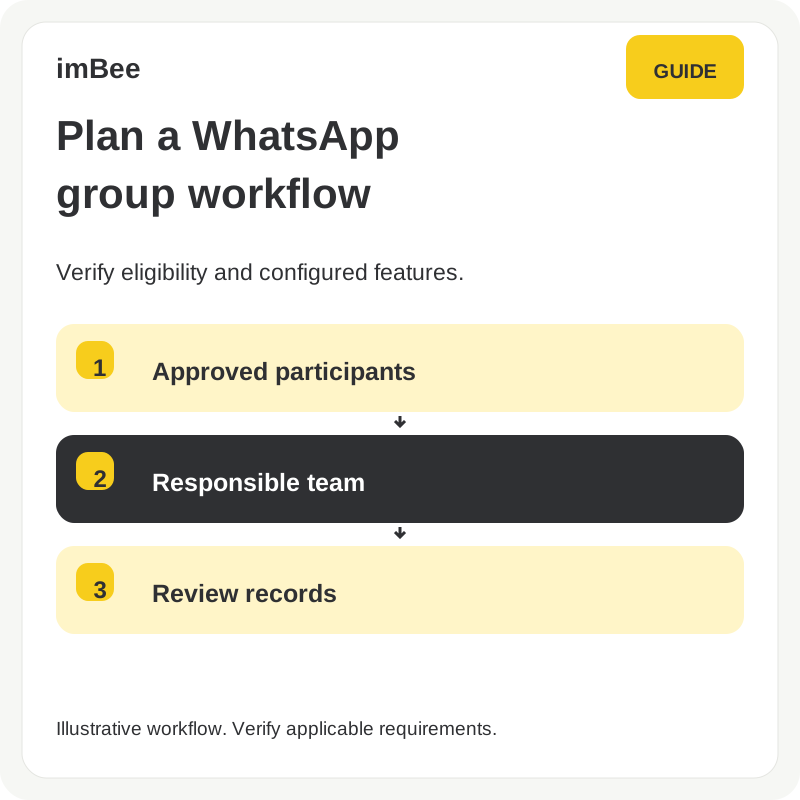
Begin with a few representative conversations. Include a routine product question, an incomplete order query, a delivery exception and a request for a person. Record the next action and its owner. If a customer-service agent must ask another team for a decision, test how that request stays visible until it is accepted. Extra access to messages is not the same as accountable service ownership.
For an illustrative retailer serving customers across shifts, the useful test is whether the next operator can find the original question and the decision already made. For an English-speaking team serving Singapore or Malaysia, also test the actual languages and wording customers use. These are hypothetical operating examples, not claims about a named imBee customer or a local service deployment.
Keep the existing setup when it meets the task and has a reliable process. Consider a connected workspace or custom implementation when verified needs exceed that process. An upgrade should remove a demonstrated problem, not simply add a more impressive product label.

A direct API integration requires someone to own the working software around it. Ask who will maintain message handling, account access, business-system connections and recovery when something fails. A provider can take on some of those tasks, but the proposal must say which ones. Neither a direct implementation nor a vendor subscription removes your responsibility to approve policies and define how your staff act on customer requests.
Compare software behavior in a trial. A message arriving in an inbox proves delivery to that workspace, not correct assignment. An automation producing a reply proves that a response was generated, not that an order was changed. Check the complete path: customer message, responsible person or queue, approved source, action permission and verified result where an action is involved.
For integrations, name the exact system and operation. Reading an order record, creating a ticket and changing a delivery address are different capabilities. Request evidence for the one you need. A general claim of hundreds of integrations is not proof that a particular connector, field or write operation is available in your account.
A certificate or vendor security statement is useful evidence for its stated scope. It does not establish that every configuration meets every legal or sector requirement. Keep the evaluation concrete: who can access conversations, which records can be exported, how access is removed and who owns retention decisions. Obtain the required account and contractual evidence for your own process instead of copying blanket regulatory conclusions from a marketing article.
| Requirement | Evidence to request | What a demonstration alone does not prove |
|---|---|---|
| Ownership | Assignment and acceptance in the selected configuration | A shared view does not prove someone owns the next step |
| Connected records | The exact system, fields and permitted operation | A connector logo does not prove the action works |
| Human handover | Receiving queue, context and unavailable-team behavior | A button does not prove end-to-end delivery |
| Access and exports | Roles and actual export/access-removal behavior | A certificate does not prove a customer workflow is compliant |
| Support responsibility | Named owner and agreed incident process | A subscription does not explain who restores the workflow |

The older conversation-based pricing explanation is not the current general charging model. Meta’s current public pricing page describes charging by delivered message, with rates determined by market and message category. Treat that as the charging unit, then check the applicable rules and rate card for the actual message mix. Do not estimate a current bill using an old price per conversation. Not every message is chargeable; check the applicable exceptions as well as the billing unit.
Keep template terminology precise. Marketing, utility and authentication are template categories; a service reply is not a fourth Service template category. Platform messages sent outside the customer-service window require the appropriate approved template under Meta’s current rules. These Platform requirements should not be applied indiscriminately to a different product such as the Business App. The customer-service window lasts 24 hours from a customer message and resets when the customer sends another message.
Template approval is not a blanket permission to contact every person in a list. Check the current business messaging policy, permission requirements, message purpose and opt-out handling before sending. Account verification, display-name decisions, badge eligibility, quality and messaging limits are separate matters. Do not promise a badge or a better quality rating merely because business verification is completed.
Ask for a cost breakdown separating Meta message charges from the software subscription, provider charges, implementation and optional services. Confirm what is included in your own contract. This guide does not change imBee’s published prices, assume that Meta’s fee treatment is passed through unchanged, or quote a universal monthly price for an enterprise.

Moving a business number is an operational change, not a sentence to copy from an old checklist. Confirm the supported onboarding path for the account and provider before deleting an app account, changing access or moving a number. Where a coexistence path is offered, verify its eligibility and actual support for your configuration. Do not assume that every migration requires the same cutover or that every account can use the same path.
Record ownership of the business account, number and implementation credentials. Agree who can approve the change and who can recover the service. Preserve the required business records through a verified process; do not promise that exporting a chat automatically imports its history into another system. Check the actual continuity requirements with the team that relies on those records.
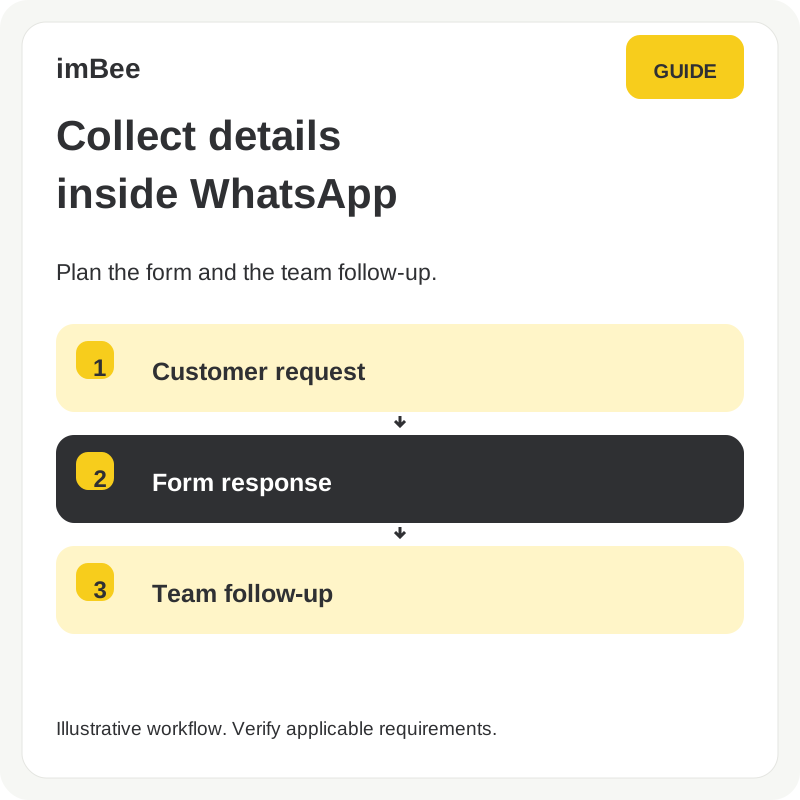
Prepare the customer and operator journeys before the cutover. Test inbound messages, allowed replies, expected templates, assignment and the human route. Include a failed connection and an unavailable operator. Agree what staff will do if a request arrives during the change, and document a recovery plan that the implementation team has actually reviewed.
Keep the first rollout bounded to a defined task and team. A small operational pilot lets you distinguish a source problem, an account issue and a workflow error. Expand when the evidence shows the selected process works consistently, not because a successful test message is presented as proof of complete readiness.

Write the acceptance criteria before reviewing the pilot. An operator should be able to identify the conversation owner, find the approved information, explain the next step and confirm the result of any real operation. A customer should be able to reach the promised human route. These are observable tests; they do not require an invented threshold for how many chats a business is allowed to handle.
Record failures as well as passes. Retest after changing sources, permissions, templates or integration settings. Keep the prior result and append the correction so that the team can see what changed. A regression library compounds operational knowledge and makes later expansion to another team or language more predictable.
Measure results against your own baseline and definitions. Response time, complete handover and customer resolution describe different outcomes. Message volume, a test pass percentage or a demo completed by a salesperson does not establish revenue or compliance. Keep qualified enquiries and real business outcomes separate from traffic and activity metrics.
imBee’s public inbox and AI Agent pages can help frame a discussion about assignment, collaboration and knowledge-based assistance. Ask the team to demonstrate the exact channel, permissions and business action you require. The useful decision is whether the complete process fits your service operation, with named responsibility and evidence, rather than whether the proposal uses App, API or Platform in its title.

No. The Cloud API is an interface within the WhatsApp Business Platform. A team inbox is a separate software layer; evaluate what it actually provides.
WhatsApp Business Account. It refers to the account in the business messaging setup, not the API itself.
Meta documents direct Cloud API implementation. A provider may supply software and operational help; compare the responsibilities and capabilities you need.
No. Check the applicable messaging policy, permission, purpose, account eligibility and opt-out process separately.
Meta’s current public pricing describes charging by delivered message. Check the applicable market/category rules and separate provider/software charges.
Do not take that step from a generic checklist. Confirm the supported onboarding path, eligibility, continuity requirements and recovery plan first.
No. Test ownership, sources, permissions, human handover and verified results in the actual configuration, then maintain those tests after changes.
Discuss your channels, team and conversation handover needs in a product demo.