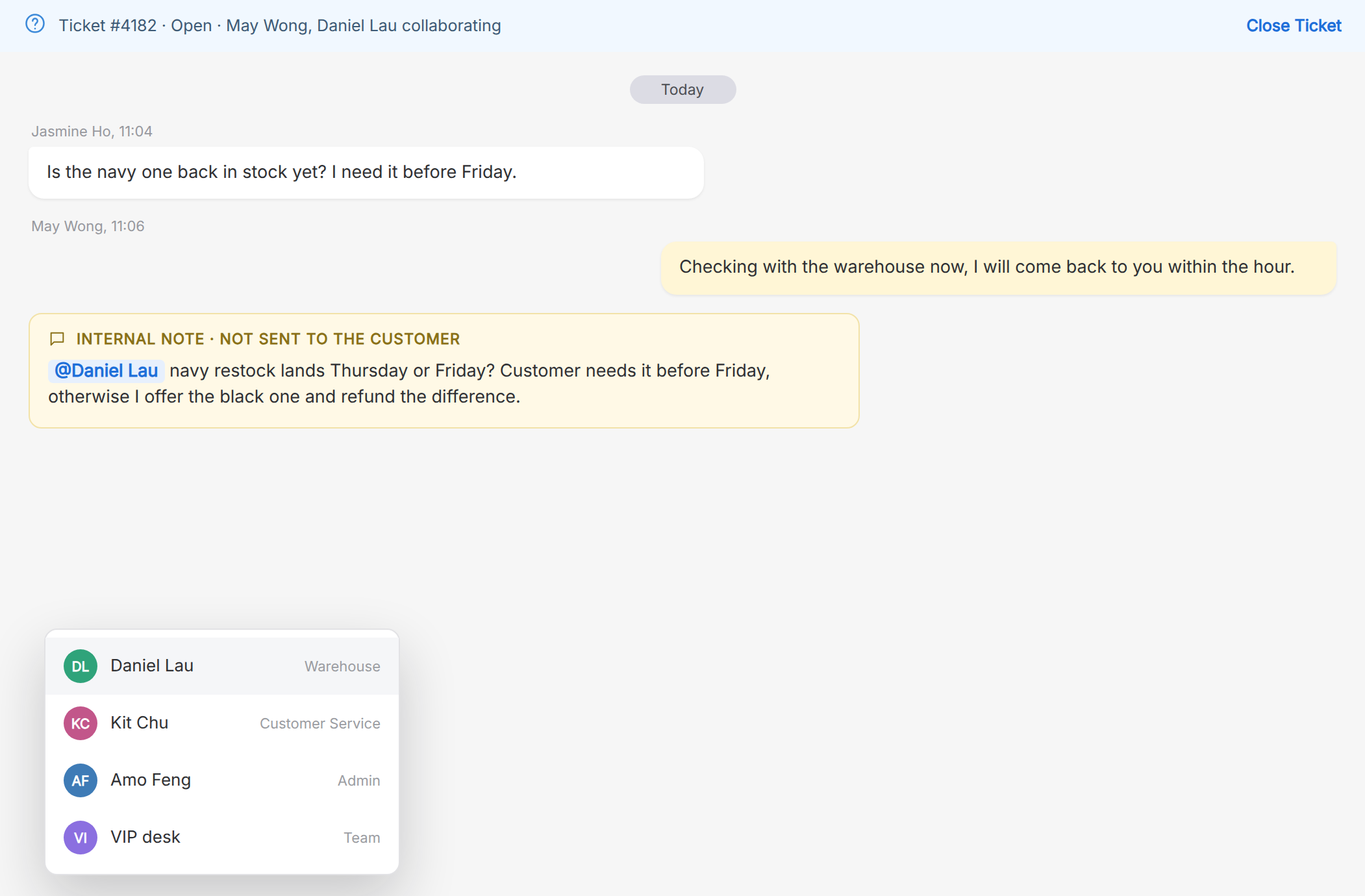
Published imBee product illustration with a retail example. It illustrates internal collaboration, not a patient record, configured healthcare process or customer result. View full illustration.
A convenient channel is useful only if the enquiry reaches the right person and the promised next step actually happens. For a Hong Kong medical centre, begin with general administrative information, such as where to find published opening hours or how to contact the reception team. Avoid starting with a broad promise of automated patient messaging.
Write a short scope before choosing software: the enquiry you will accept, the approved source for the answer, the person who owns the queue, the backup and the route for questions outside that scope. An appointment-specific message can reveal more than the sender intends. A short message is not automatically a low-risk one.
Keep three decisions separate. Meta’s channel rules determine which messages may be sent. The supplier’s workspace determines the available access and workflow controls. Your organisation determines who may use those controls, what information belongs in the conversation and when a person must intervene. Evidence from one layer does not settle the other two.

Use a small scope that staff can explain consistently. The initial reply should guide someone to approved information or a designated contact route. It should not invite them to paste a medical history into a general enquiry thread.
Swipe or scroll sideways to compare all columns.
| Enquiry | Initial handling | Boundary to document |
|---|---|---|
| Published hours or location | Use the current approved page; name its owner. | Escalate a conflict or missing detail. Do not guess. |
| Request to speak with reception | Explain the actual contact route and staffed hours. | Do not imply that an appointment has been booked. |
| Medical question or unexpected health information | Stop the general-information flow and use the designated process. | Do not generate medical advice or copy sensitive details into a broad team note. |
| Complaint, wrong recipient or request to stop messages | Send to the responsible team under the agreed procedure. | Record the required action and verify it was carried out. |
These are workflow recommendations, not a determination that a proposed healthcare use is permitted. The PCPD’s data protection principles provide the underlying Hong Kong privacy reference. Have the responsible team assess the actual data flow, including access by suppliers, before introducing real information.


A conversation can be assigned and still remain unattended. Define an observable handover: who receives it, which details they need, how they accept it and what happens if they are absent. Agree a realistic response expectation and a route for work left open at the end of a shift.
Identify the approved administrative topic.
A named role holds the enquiry; a backup is defined.
The receiving team takes responsibility for an exception.
Give the actual next step; close only with evidence.
For the internal note, distinguish what the customer asked from what staff inferred. Include the enquiry topic, the approved information already shared, the reason for escalation, the receiving role and the agreed follow-up. Use only the context needed for that task. Do not turn a handover note into a second patient record.

Use invented data for the first demonstration. The example below concerns general reception information. It does not describe an imBee customer deployment, a medical decision or an achieved improvement.
“Where can I check your reception hours?”
Share the approved public information page. Do not add unverified opening hours.
“That page does not show the reception desk I need. Can someone help?”
Reference DEMO-ADMIN-01. Reception information unresolved. Published page already shared. Receiving role: reception supervisor; backup: duty coordinator.
Explain the agreed reception contact route and staffed hours. Do not claim that a booking, callback or other action has occurred unless it has.
Record a pass only for the behaviour observed. If the demonstration needs a manual step, keep that step visible in the operating process and cost estimate.
On the WhatsApp Business Platform, a customer message opens or resets a 24-hour service window; outside it, approved templates are required. Opt-in and opt-out rules still apply. Automation needs a clear escalation route. Meta also restricts health-information use where applicable regulations require heightened protections that the systems do not meet. Review the current WhatsApp Business Messaging Policy for the proposed use.
Meta currently charges by delivered message, category and recipient market, with exemptions including service replies and qualifying utility messages within the service window. Other exemptions and volume tiers can affect the bill. Use the current Meta pricing reference and separate those charges from your supplier’s fees. Do not budget using the old conversation-based model.
The Business Platform is the messaging infrastructure; it does not by itself establish a configured shared inbox, a booking connection or a complete operating process. Request evidence for each capability your centre needs.
Turn the demonstration into a short written record. A brochure describes a capability; an observed test and current supporting documents help you decide whether it meets your requirement. Ask for the scope of each control rather than accepting an unqualified “yes”.
Swipe or scroll sideways to compare all columns.
| Requirement | Evidence to request | Decision record |
|---|---|---|
| Access and removal | Show intended roles, restricted access and removal of a test user. | Required role: ___ · Observed: ___ · Owner: ___ |
| Accepted handover | Run the normal and absent-receiver cases with staff. | Receiving role: ___ · Backup: ___ · Open gap: ___ |
| Storage and suppliers | Document hosting locations, subprocessors, support access and contractual responsibilities. | Document/version: ___ · Assessment owner: ___ |
| Retention, export and exit | Show what can be exported or removed, by whom, and any limits or retained copies. | Observed result: ___ · Unresolved limit: ___ |
| AI, if proposed | Identify approved sources, data use, model providers, escalation and disablement. | Allowed task: ___ · Excluded task: ___ |
| Integration, if required | Name the exact system and read/write operation; test success, failure and duplicate requests. | Evidence: ___ · Not demonstrated: ___ |
Assign an owner and next action to every unresolved requirement. Do not average a missing essential control into a favourable overall score. If the supplier cannot demonstrate a requirement, mark it unresolved and narrow the pilot or retain the manual process until the gap is addressed.
For a product discussion, use the imBee healthcare overview as a starting point, then request a demonstration against this worksheet. A product page is not evidence of your centre’s configuration or a legal approval.
No. A shared inbox does not establish that a particular use of personal or health information is permitted. Assess the intended content, notices, access, retention and supplier arrangements with the people responsible for privacy and clinical governance before using real information.
The workflow described here handles general administrative enquiries. It does not book appointments or update patient records. Any such integration needs its own scope, permissions, failure checks and confirmation from the system that actually performs the action.
The receiving person or queue has the necessary context, responsibility has been accepted, and the customer has an accurate next step. A tag or assignment notification alone does not prove that a person has taken over.
Separate current Meta message charges from the supplier subscription, implementation and ongoing support. Meta pricing depends on delivered messages, category and market, with exemptions. Request an itemised estimate for your actual message mix rather than a single price per conversation.
No. Keep this pilot to approved general administrative information. Route medical questions and unexpected health information through the organisation’s designated process. A fluent answer or an automatic acknowledgement is not a clinical assessment.
Discuss your channels, team and conversation handover needs in a product demo.